
Criminal Court Cases in Buchanan County
Buchanan County criminal cases do not all remain in one court. The Buchanan General District Court tries misdemeanors and traffic charges, conducts initial proceedings, and decides whether a felony has enough evidence to move forward. The Buchanan Circuit Court, part of Virginia's 29th Judicial Circuit, tries felony charges, receives grand jury indictments, imposes felony sentences, and hears appeals from district court. The Juvenile and Domestic Relations District Court has defined adult family-related jurisdiction, but confidential juvenile case information is not available through the public online search.
Both clerk counters are at 1012 Walnut Street in Grundy, yet they have different files, mailing addresses, phone numbers, and hours. The Circuit clerk operates from 8:30 a.m. to 5:00 p.m. at 276-935-6567. The combined District clerk operates from 8:00 a.m. to 4:00 p.m. at 276-935-6526. Start with the court shown on the docket result. Sending a felony-trial request to the lower-court clerk can miss the final order even when that court held the first hearing.
The official Buchanan Circuit Court page identifies the active clerk's office and current local policies.
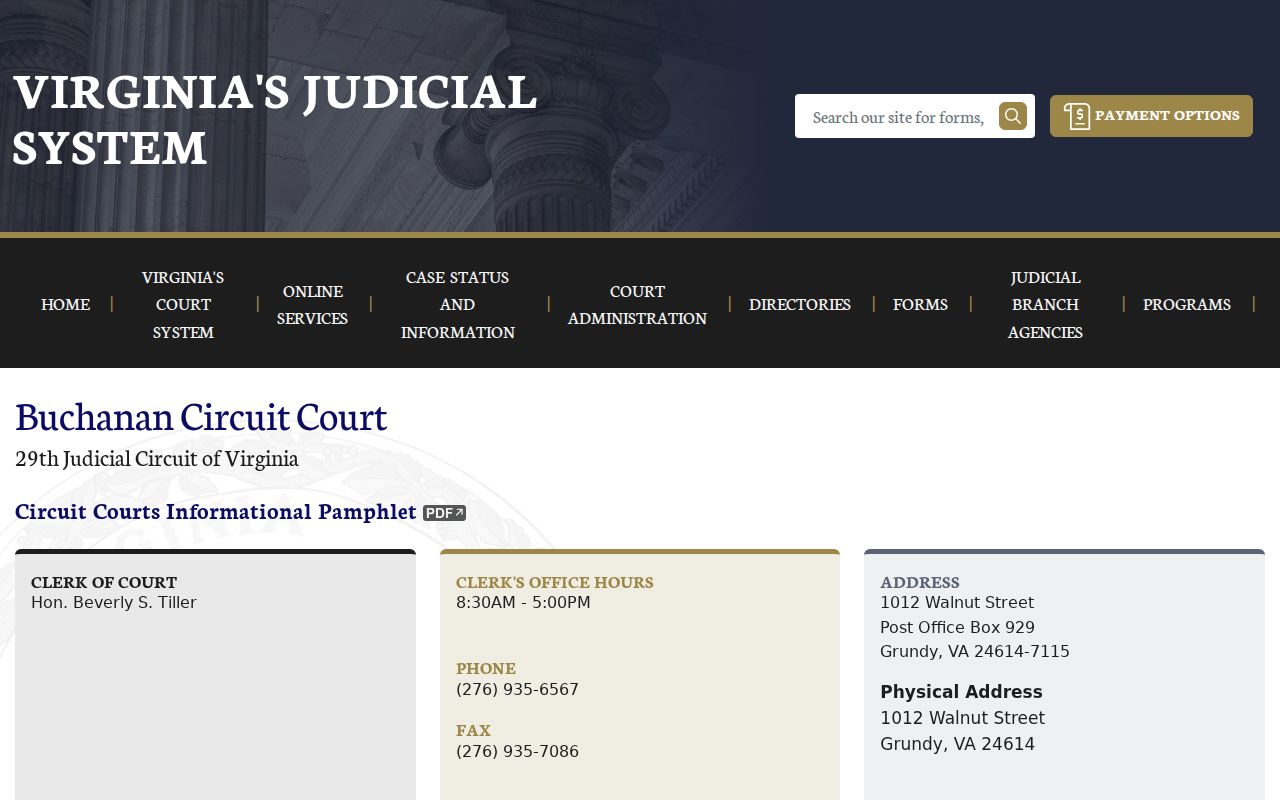
That court page is the sound source for counter hours, court terms, contact details, and rules that may change before a visit.
Buchanan County Criminal Docket Days
The local schedule can help a searcher tell which agency and court track to check. State Police traffic matters and arraignments appear on Monday mornings, while State Police misdemeanors and felony preliminary hearings also run Monday. Town of Grundy Police cases are set on the second and fourth Thursdays. Buchanan County Sheriff's Office cases appear on the first through fourth Thursdays. On those Thursday dockets, arraignments begin at 8:30 a.m., misdemeanors at 9:00 a.m., and felony preliminary hearings at 11:00 a.m. Contested matters receive later time slots.
This schedule identifies a likely record holder, not a guaranteed hearing date. Continuances and court orders can change the calendar. Use the case number and the defendant's current notice when accuracy matters. The Buchanan Combined Courts schedule is the source to check for current local settings.
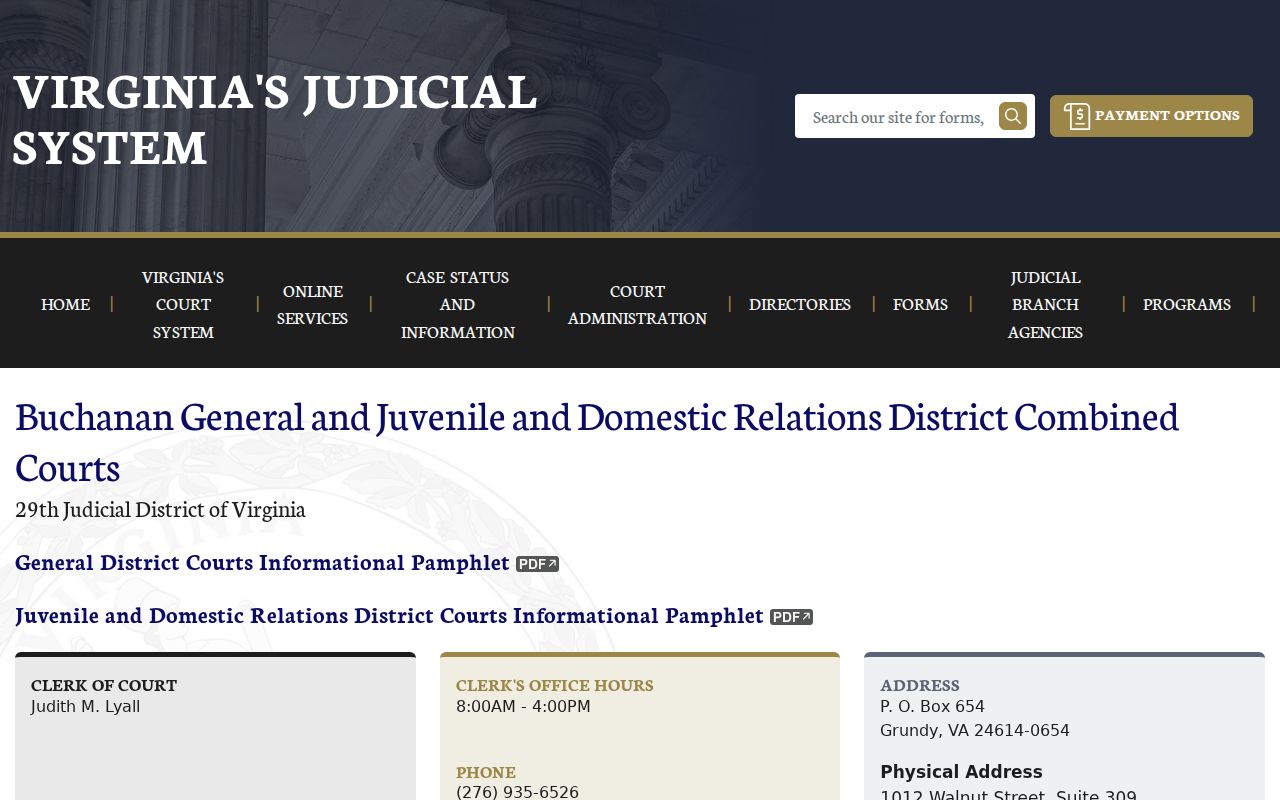
The published schedule also separates adult criminal work from confidential juvenile proceedings, which explains why a name search may not show every courthouse matter.
Buchanan County Case Record Searches
The Virginia Judicial System Online Case Information System 2.0, or OCIS 2.0, searches criminal and traffic information from General District Courts and participating Circuit Courts. Not every circuit participates, and OCIS cannot accept payments. A result is an information lead. The clerk remains the source for an official copy and can explain whether a pleading, sentencing order, or exhibit is open for inspection.
- Open OCIS and accept the system acknowledgment before entering search terms.
- Choose name, case number, or hearing date. Select Buchanan County and the correct court level when the search mode asks for them.
- Use the legal spelling from a summons, warrant, or notice. A known case number is safer than a common name.
- Open the charge-level details and read the hearing, disposition, and service entries instead of relying only on the result row.
- Take the case number to the General District or Circuit clerk and ask for the exact public document, plain copy, or certified copy needed.
| Field label | Type | Required | Notes |
|---|---|---|---|
| Court or locality | Dropdown | Mode dependent | Select Buchanan General District or Buchanan Circuit where available. |
| Search by | Tabs or radio | Yes | Name, case number, or hearing date. |
| Last name | Text | Name mode | Use the legal surname and narrow common names. |
| First and middle name | Text | System dependent | Middle name can help distinguish people. |
| Case number | Text | Case mode | Enter the court's format exactly. |
| Hearing date | Date | Date mode | Use the listed calendar date. |
| Court level or type | Filter | Optional | Limit results to General District or participating Circuit coverage. |
| Acknowledgment | Checkbox or button | Yes | Accept the terms before searching. |
The General District case-search interface remains useful for locality-specific queries.
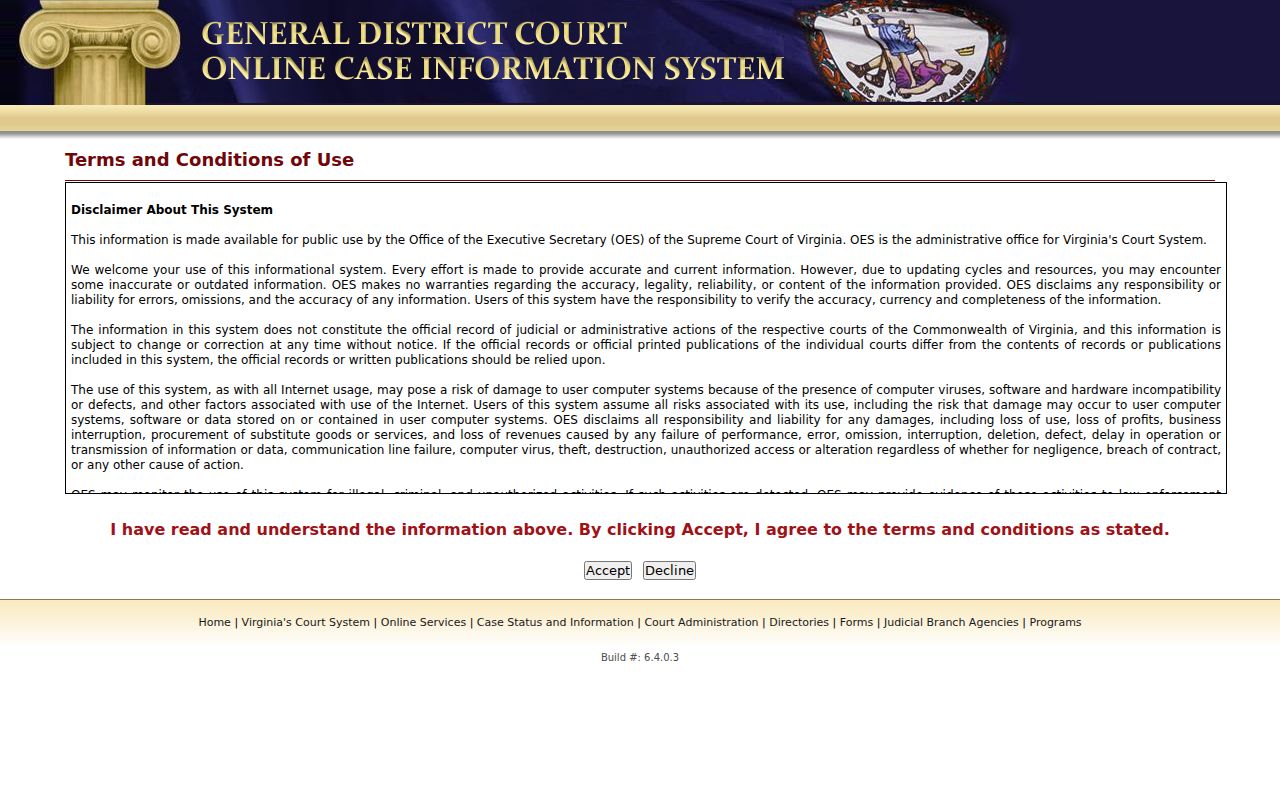
Its current, archived, and all-data choices can help with older entries, but the clerk must still confirm the file and disposition.
Buchanan County OCIS Case Search Controls
OCIS name entries need at least two characters. The court's help says many punctuation marks are ignored or replaced with spaces, while the characters @, #, and $ remain. Legacy General District searches support an asterisk wildcard with at least two other characters. Case-number patterns also reveal court type: General District criminal numbers use a GC form, traffic numbers use GT, and Circuit criminal examples use CR. A JA number points toward Juvenile and Domestic Relations records, where public display is sharply limited.
Results can list court, case number, defendant, offense date, hearing date, charge, and Code section. Detail groups may include defendant, case or charge, appeal, hearing, disposition, and service of process. OCIS leaves out several protected proceeding types and does not promise downloadable pleadings. Sessions time out, and the judiciary cautions against using the browser Back button, double-clicking, or bookmarking an internal results page.
The OCIS 2.0 landing screen shows the statewide entry point and acknowledgment process.
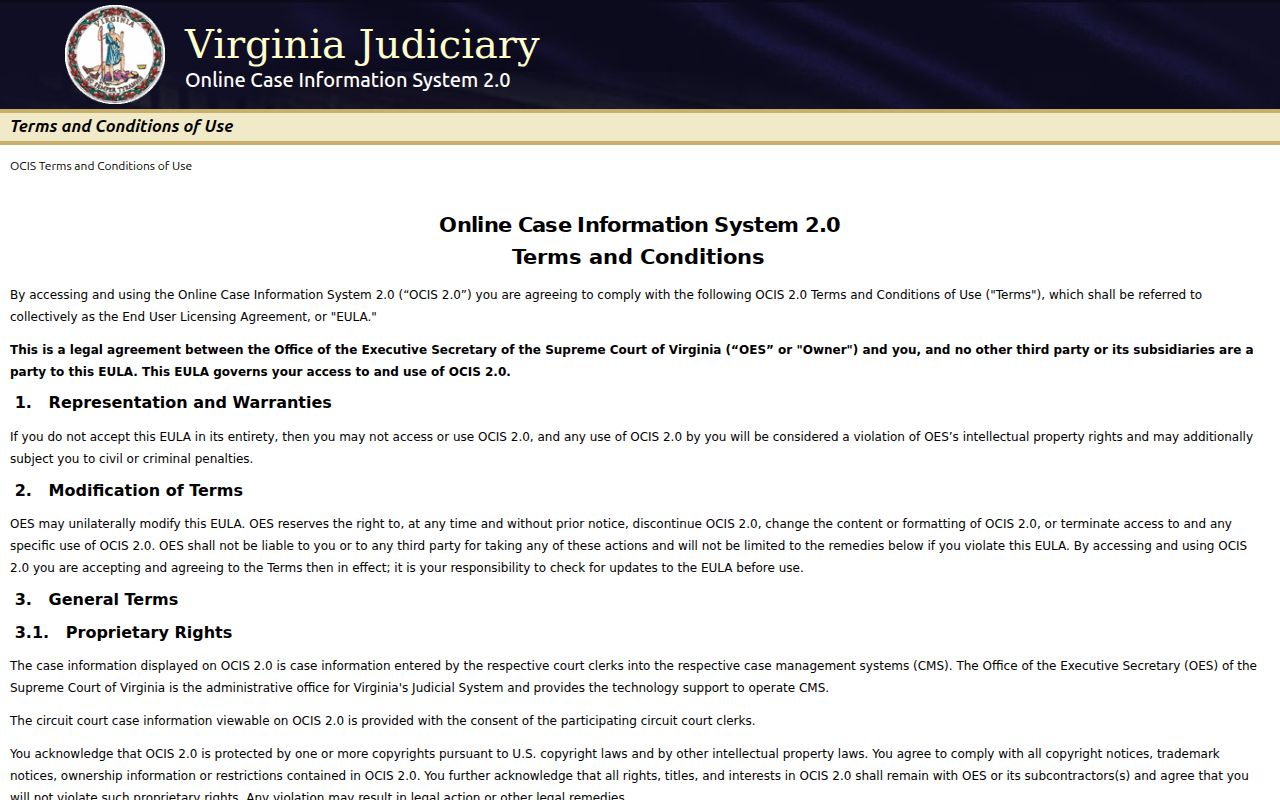
The statewide view broadens a search, but Buchanan Circuit coverage should be checked live because circuit participation can vary.
What a Criminal Case File Contains
A Buchanan County criminal case file is centered on a filed charge. It may carry much more detail than an arrest entry or statewide criminal-history summary. Ask for the document that answers the question. A final order establishes the court's result; a sentencing order states the sentence; a docket sheet traces events; and the indictment or warrant states the accusation at a specific stage.
| Case number and court | The court-specific identifier and the Buchanan clerk responsible for the file. |
|---|---|
| Charging document | The warrant, summons, complaint, or indictment that states the accusation for that stage. |
| Docket entries | Hearings, continuances, motions, counsel entries, and other recorded case events. |
| Hearing dates | Scheduled or completed settings, which must be checked against current court notice. |
| Disposition and judgment | The charge-level result, such as guilty, dismissed, acquitted, or nolle prosequi. |
| Sentence and conditions | Confinement, probation, fines, costs, restitution, and other terms when ordered and public. |
Online status can be incomplete, inaccurate, or out of date. It does not replace a certified clerk record. Full birth dates, Social Security numbers, victim identities, sealed material, and protected addresses should not appear in an ordinary public result.
One Buchanan Felony, Two Courts
A felony can produce records in both Buchanan courts. General District Court handles the arraignment, counsel issues, bail-related proceedings, and preliminary hearing. If the judge finds probable cause, the charge may be certified to a grand jury. A true bill, meaning an indictment returned by that jury, begins the Circuit Court felony phase. Circuit Court then handles motions, plea or trial, sentencing, and later proceedings.
The lower-court entry and Circuit file may use different case numbers. A dismissed preliminary charge can also coexist with a later indictment framed under another count or statute. Search both levels when the first result stops at certification or dismissal without explaining the final outcome. The proper endpoint is the last charge-level disposition, not the earliest arrest allegation.
Note: A case marked disposed has an entered outcome, but the word does not mean the person was convicted.
Criminal Case Stages in Buchanan County
The file grows as the charge moves. Police or a magistrate first supplies process, and the prosecutor decides what charge to pursue in court. General District Court addresses the early stage for misdemeanors and felony accusations. A misdemeanor can end there after plea or trial. A felony supported at preliminary hearing moves toward a grand jury and then a Circuit Court file.
Case flow: Charges Filed › Arraignment › Pretrial › Plea or Trial › Disposition › Sentencing
Each step can leave a different entry. Arraignment addresses the charge and rights. Pretrial work can include motions and continuances. A plea is the defendant's formal response. Disposition is the outcome of each charge. Sentencing follows a conviction but may occur on another date. Appeals and post-judgment motions may then add records to a new or existing file.
Reading Buchanan Criminal Case Outcomes
Read outcomes one charge at a time. Acquittal means a not-guilty outcome. Dismissal ends that charge without a conviction. Nolle prosequi means the prosecutor formally chose not to proceed at that time. A conviction is a judgment of guilt after a plea or finding. A deferred disposition delays final adjudication while the person completes conditions, so its later effect depends on the controlling statute and final order.
- True bill
- A grand jury returned an indictment that permits the felony prosecution to proceed.
- No bill
- The grand jury did not return the proposed indictment.
- Capias
- Court process directing custody, often tied to a failure to appear or an alleged violation.
- Recognizance
- Release based on a promise and conditions rather than secured money.
- Concurrent sentence
- Sentences served at the same time to the extent the order allows.
Financial balances are separate from guilt and sentence status. If an abbreviated entry is unclear, ask the Buchanan clerk for the public final order. Court staff can supply records, though they cannot give legal advice or interpret the order for a party.
Buchanan Criminal Cases in Archives
Older Buchanan County court records can require an archive search rather than an online query. The Library of Virginia reports that an 1885 fire destroyed courthouse records and that a 1977 flood caused severe damage. Those events can explain gaps that are not caused by sealing or a spelling error. The active clerk can say whether a criminal book or file remains onsite, was transferred, or has a microfilm counterpart.
The Library of Virginia's Buchanan County microfilm inventory is the official starting point for historical holdings.
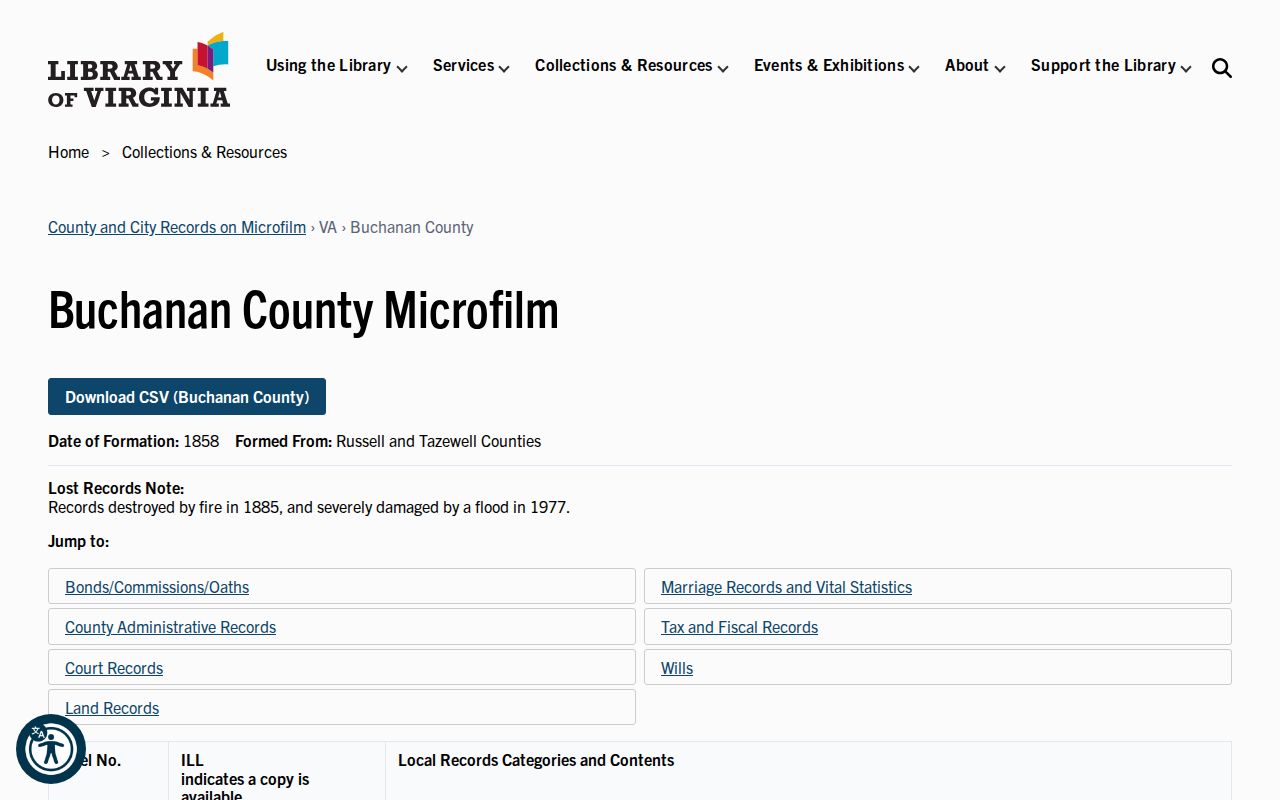
The inventory helps narrow the record series and date span before contacting the clerk or archive, but it does not prove that a named case survives.
Access Rules for Case Records
Virginia Code § 17.1-208 generally directs Circuit clerks to permit inspection and furnish copies of office records, subject to law, fees, and restrictions. Judicial case access is governed chiefly by court rules and the clerk's statutory duties, not by treating each case-file request as a routine executive-branch FOIA request. Ask the clerk about current copy and certification charges because a local schedule was not published in the researched county directory.
Juvenile cases, sealed records, protected proceeding types, victim information, full birth dates, Social Security numbers, and confidential addresses can be withheld or redacted. A missing online result may also stem from name variation, a filing delay, an archived record, or nonparticipating Circuit coverage. Confirm the cause before assuming that no case exists.
For broader context on repository, arrest, jail, and court records, use the Buchanan County criminal history overview. It explains why a case file and a CCRE history answer different questions.